
In late January of 2025, the Gulf Coast experienced a historic winter storm, with accumulating snow from southern Texas all the way into the Florida Panhandle. The storm was a generational one for the region with numerous daily snowfall records being broken. In Florida, the longstanding annual snowfall record of 4 inches was shattered when 9.8 inches fell in the town of Milton. But as remarkable as the 2025 snowstorm was, it still could not live up to the legendary Valentine’s Day Gulf Coast Snowstorm of 1895. To this day, this storm still holds many of the Gulf Coast’s all‑time snowfall records. So let's dive right into how this storm came to be and just how much snow fell.
As we all know, accumulating snow along the Gulf Coast is extremely rare, as cold air typically struggles to make it that far south. However, the winter of 1894–1895 was an exceptionally cold one for the eastern United States, including the southeast US. Historical records from Houston, TX show that February 1895 was the coldest February on record. The coldest month on record goes to January 1978.
.png)
With that stated, the month actually began and ended on the mild side. Conditions changed dramatically though once an arctic front pushed through the region around February 7 and sent temperatures tumbling. A reinforcing surge of arctic air arrived on February 12–13, providing the necessary cold air in place for what would become one of the most extraordinary southern snowstorms in recorded history.
Because meteorological data from the late 19th century is limited to the technology of that time, reconstructing the exact storm setup is challenging. However, the available information suggests an upper‑level low developed over southeast Texas or just offshore in the Gulf. This system combined with the deep, dense arctic air mass already in place overnight on February 13 and into February 14. The result: prolonged periods of heavy snow from southeast Texas to southern Louisiana on Valentine’s Day. Snow fell for more than 24 hours in spots before the system finally moved eastward over the Southeast and Florida Panhandle, exiting on February 15.
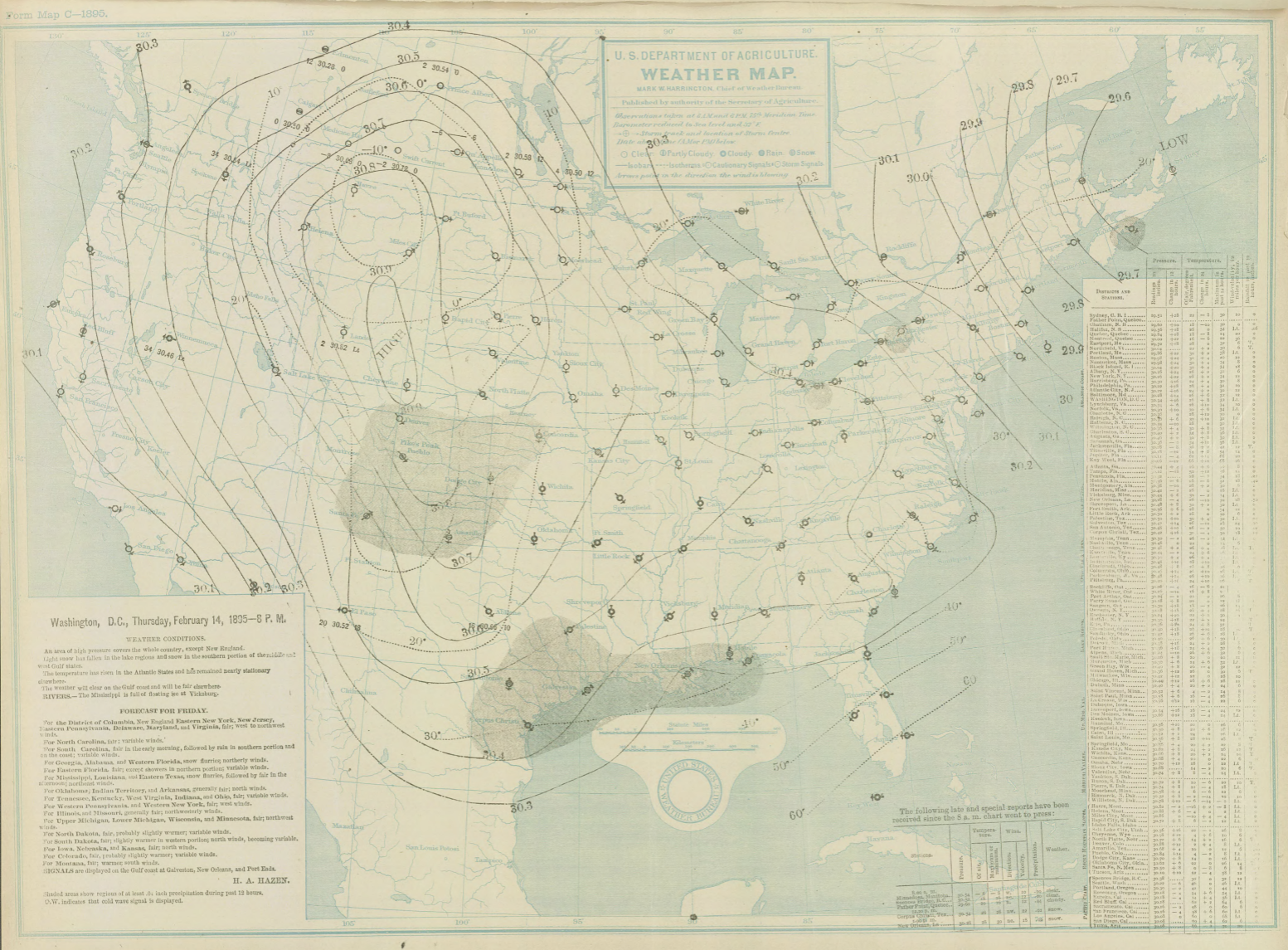
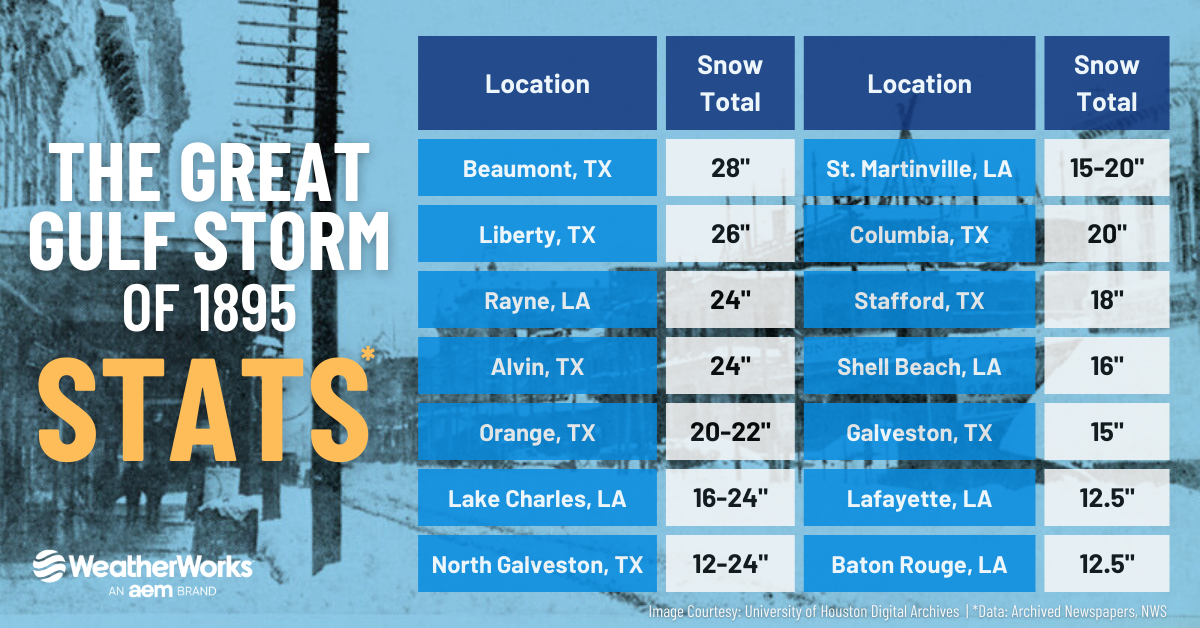
The snowfall totals from this storm remain some of the most extreme observations ever documented along the Gulf Coast. So let’s go over several locations throughout the southeast to highlight how historical this storm was…
Southeast Texas experienced some truly astonishing snow. First, spots around Houston recorded 20 inches, which is an amount unmatched in the city’s recorded history. Since then (over roughly 130 years later) the city has only documented about a dozen measurable snowfall events. The second‑largest total was 4.4 inches in 1960 (also on Valentine’s Day). In other words: the 1895 storm produced nearly four times the snowfall of Houston’s second biggest event.
Other locations across southeast Texas were hit just as hard. Much of the region saw double‑digit accumulations, including a staggering 28 inches in Beaumont, around 15 inches in Galveston, and 12 inches in Victoria, to name just a few. Unprecedented amounts also occured in southern Louisiana as well. For instance, Lake Charles received anywhere from 16 to 24 inches, 12.5 inches in Baton Rouge, and New Orleans reported between 8–10 inches around the city. It should be noted that because these totals were taken over a century ago, most of these totals should be considered as close estimates, as it is hard to exactly verify them. Even so, none of these totals have been approached ever since (with the exception of New Orleans picking up as much as 11-12 inches from the 2025 January snowstorm).
As the storm moved east, it continued dropping snowfall across southern Mississippi, Alabama, Georgia, and the Florida Panhandle before lifting north into the Carolinas and Virginia. Parts of the Florida Panhandle picked up around 4 inches, a benchmark that would stand until it was surpassed by the aforementioned January 2025 winter storm.
Farther southwest, Brownsville, Texas (situated directly on the Mexican border) recorded 5 inches from this event. According to the National Weather Service, the city did not see accumulating snow again for more than a century, with 1.5 inches falling on Christmas Day 2004.
Perhaps the most extraordinary aspect of the 1895 Gulf Coast storm was just how far south snow was observed. Flurries were reported at sea level as far south as Tampico, Mexico, located at 22.18°N latitude, south of the Tropic of Cancer! This remains the furthest south snowfall has ever been recorded near sea level in the Western Hemisphere. For perspective, this latitude aligns with the Egypt–Sudan border, the Hawaiian island of Kauai, and just south of Hong Kong.
While the snow created a winter‑wonderland appearance for the southeastern United States, the impacts were severe, especially considering this occurred over 100 years ago with minimal technology and being completely unequipped to handle such conditions. Several fatalities were reported due to the combination of extreme cold and the sheer volume of snow. Livestock losses were also significant throughout the Southeast, with the Livestock Association estimating that cattle losses exceeded 25 percent.

Snowfall of this magnitude would disrupt travel even by today's standards in regions accustomed to winter weather. And for many across the south last year, that ceratinly happened. In 1895, however, the effects were far more crippling than today. Much of the Southeast came to a complete standstill. In Houston, streetcars were abandoned in place as the tracks became impassable. Metal plows had to be fabricated on the spot to clear the rails. It took several days before the tracks were even passable again and streetcar service could be restored.


